What to Write Down About People: 13 Categories That Matter
For about a year I kept notes about people, and almost all of them were useless. I'd open the one titled "Lena" three months after meeting her and find a single line: "really nice, talked about work." Thanks, past me. Extremely actionable.
The problem wasn't discipline — I was writing things down. The problem was that I didn't know what to write down about people, so I wrote down impressions instead of details. Impressions fade into nothing. Details survive.
What fixed it was having categories. When you know the shape of the box you're filling, you stop writing "nice person" and start writing "allergic to walnuts, brother lives in Lisbon, wants to try pottery." Here are the 13 categories I've landed on, why each one earns its place, and what a note in it should actually look like.
The test for whether something is worth writing down
Before the list, one filter that saves a lot of time:
Would knowing this change how I show up next time I see them?
That's it. "She seemed stressed" doesn't pass — it's an impression with a shelf life of a week. "Her funding round closes in October" passes, because in November you can ask about it. Run everything through that question and you'll write less and keep more.
What to write down about people: the 13 categories
I group them in three tiers — emotional, personal, and special. The at-a-glance version:
| Tier | Category | A good note looks like |
|---|---|---|
| Emotional | Loves | "Open-water swimming — did the Bosphorus crossing in 2024" |
| Emotional | Likes | "Flat white, oat milk. Mid-season on Slow Horses" |
| Emotional | Dislikes | "Loud restaurants; won't do surprise parties" |
| Emotional | Hates | "Don't bring up her old agency — left on bad terms" |
| Personal | Basics | "Met at Jonas's wedding, Aug 2025. Lives in Ghent. Name is Lena, not Lena" |
| Personal | Dates | "Birthday 12 March. Knee surgery 4 Nov 2026" |
| Personal | Family | "Partner Sam; kids Mira (7) and Jonas (4)" |
| Personal | Trivia | "Grew up in Porto, first concert was Blur" |
| Personal | Profession | "Physio, opening her own practice in spring" |
| Special | Allergies | "Walnuts — serious. Also no gluten" |
| Special | Wishes | "Keeps saying she wants to try pottery" |
| Special | Pets | "Basset hound, Amy" |
| Special | Gifts | "Gave her the Ottolenghi book in 2025 — don't repeat" |
Now the why behind each.
The emotional categories
These are the four that make someone feel known rather than merely tracked.
1. Loves
Not everyday preferences — the things that light someone up. The sport they organise their year around, the sibling they'd drop anything for, the music they get genuinely evangelical about.
You'll use this category twice: for real conversation openers ("did you end up doing the crossing again?") and for the gifts that land, the ones that say I was paying attention.
2. Likes
The everyday layer. Coffee order, the show they're halfway through, their team, the way they take their tea. Individually trivial — collectively, this is what lets you get someone the right thing without asking.
3. Dislikes
Mild aversions, and they're mostly about planning. Doesn't drink. Hates loud restaurants. Won't do anything involving a boat. Knowing three dislikes makes you dramatically better at suggesting where to meet.
4. Hates
The strong stuff — including topics. An ex's name, a job they left badly, the family member who isn't spoken to. This is the category that stops you putting your foot in it, and it's the one people most often wish they'd written down after the fact.
The personal categories
The factual backbone. Less emotionally warm, most frequently used.
5. Basics
The identity layer: how you know each other, where they live, what they're called and how it's spelled. Name spelling is wildly underrated — getting "Lena" vs. "Lehna" right on a card is a small thing that reads as care.
6. Dates
The highest-return category in the whole list, and it's not close. Birthdays and anniversaries, obviously — but also the one-off dates: surgery next Tuesday, the exam in June, first day at the new job. A recurring date is nice. A one-off date you remembered to ask about is unforgettable to the person on the other end.
For the recurring ones, what you write down matters less than when you're reminded — a birthday reminder that arrives on the day is too late for anything that has to be posted.
7. Family
Names, not relations. "How are the kids?" is a pleasantry; "how's Mira settling into school?" is a conversation. Partner, children and their ages, siblings, parents, the ones who are ill and the ones who are far away.
8. Trivia
The stories. Where they grew up, the summer in Lisbon, the first concert, the thing that happened at their old job that they tell well. This category has no immediate use — it's the raw material of a friendship that has a history, and it's the first thing to evaporate if you don't catch it.
9. Profession
What they actually do, not their job title. What they're working toward, which project is grinding them down, whether they're trying to leave. Six months later, "did you get out of that project?" is worth ten "how's work?"s.
The special categories
Narrow, high-value, easy to forget you needed until you needed them.
10. Allergies
Allergies, dietary rules, health constraints. This is the highest-stakes category on the list — the one where forgetting doesn't just look careless, it can genuinely hurt someone. Walnuts. Gluten. The knee that isn't running yet. Write these down the second you hear them, even if you're sure you'll remember.
11. Wishes
Things people say they want, out loud, without meaning it as a hint. "I keep meaning to try pottery." "My headphones are dying." These sentences fall out of conversations constantly and are forgotten within the hour — by both of you. Which is exactly why acting on one six months later feels a little bit like magic.
12. Pets
Name and breed. Asking about someone's dog by name is a cheat code, and I don't fully understand why it works as well as it does.
13. Gifts
Run it in both directions: ideas for them, and what you've already given them. The second half is the one people skip, and then buy someone the same book twice. Ask me how I know.
How much detail is too much
One line per fact, in the person's own words where you can manage it. Don't write paragraphs — you'll never reread them.
The difference between a note that works and one that doesn't is usually specificity plus a timestamp:
| Vague, ages badly | Specific, still useful next year |
|---|---|
| "Likes wine" | "Orange wine; finds oaky chardonnay undrinkable" |
| "Has kids" | "Mira (7, started school Aug 2026), Jonas (4)" |
| "Health stuff" | "Left knee, ACL surgery Mar 2026 — no running yet" |
| "Wants something for the kitchen" | "Mentioned a cast-iron pan, Jan 2026" |
Add the date when the fact is time-sensitive. "Two kids" is true forever; "kids aged 7 and 4" quietly becomes wrong.
What not to write down
A boundary I'd hold to, and the reason I trust my own notes:
Write everything as if they'll read it one day.
That rules out a few things — judgments you wouldn't say to their face ("bad with money"), gossip about third parties who never told you anything, and sensitive health detail beyond what affects how you host them. It's the difference between notes that help you care about someone and notes that feel like a file on them. If a line would embarrass you on their screen, it's not a memory, it's an opinion. Leave it out.
Where to actually keep all this
The categories matter more than the tool. A notebook with 13 headings genuinely works. So does a spreadsheet with a row per person, if you're the kind of person who opens spreadsheets voluntarily — I compared the realistic options, including doing nothing, in how to remember details about people.
I'll be transparent about my bias: I built Remember Them, an iOS app organised around exactly these 13 categories. You type or say what you just heard — "Lena's allergic to walnuts and her birthday is 12 March" — and it files the details under the right person and category, with reminders for the dates. Everything stays on your device and your personal iCloud, there's no account and no tracking, and you can export the lot as JSON whenever you like. The core app is free; the AI sorting is capped at three a day unless you subscribe.
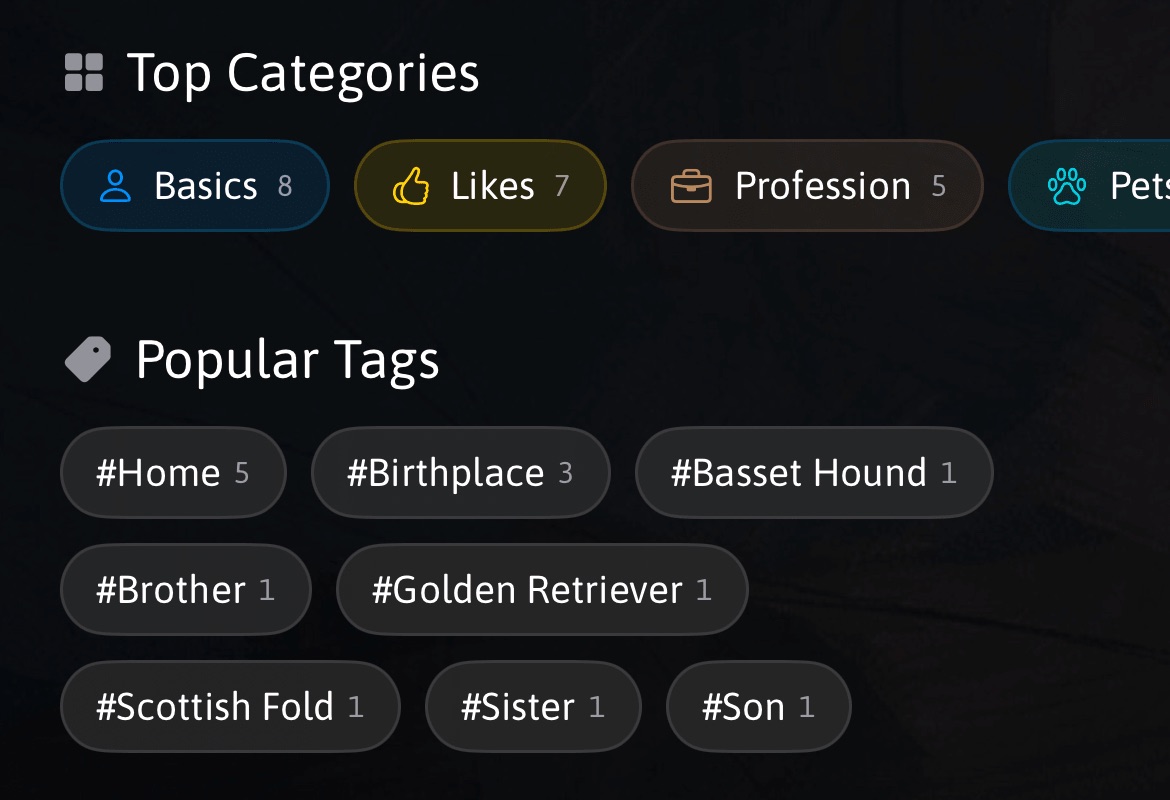
But if you take one thing from this post, take the list, not the app. Thirteen headings in a paper notebook will beat the best software you never open.
Frequently asked questions
What should I write down about someone I just met?
Three lines, maximum. How you met and where they are now (basics), one thing they actually care about (loves, or what they're working on), and one date or detail you can follow up on later. Anything more and you're writing a dossier instead of a note — and you'll be too self-conscious to do it again next time.
How much should I write down about one person?
However much you'll realistically reread. One line per fact, ten good lines per close friend. Depth matters more than breadth: eight specific details about your brother-in-law are worth more than one vague line each about forty acquaintances.
What should you not write down about someone?
Judgments, gossip about people who aren't in your notes, and sensitive information they'd be uncomfortable seeing written down. The working rule: write it as though they might read it one day. Facts that help you care for someone are fine — opinions about them aren't.
How do I remember to actually write things down?
Capture within minutes, not days — on the walk to the car, waiting for the train, before you unlock the front door. Attach it to something you already do so it isn't a new habit, just a new step in an old one. That single habit does more work than every memory technique combined, which is why it's the one I keep coming back to.
Start with four
Thirteen categories is a lot to hold in your head on day one, so don't. Start with dates, allergies, family names, and gift ideas — those four cover the situations where forgetting actually costs something, and they'll pay you back within a month.
The rest fill themselves in over time. That's the strange thing about keeping notes on the people you love: it doesn't feel like admin after a while. It feels like the record of having paid attention.